
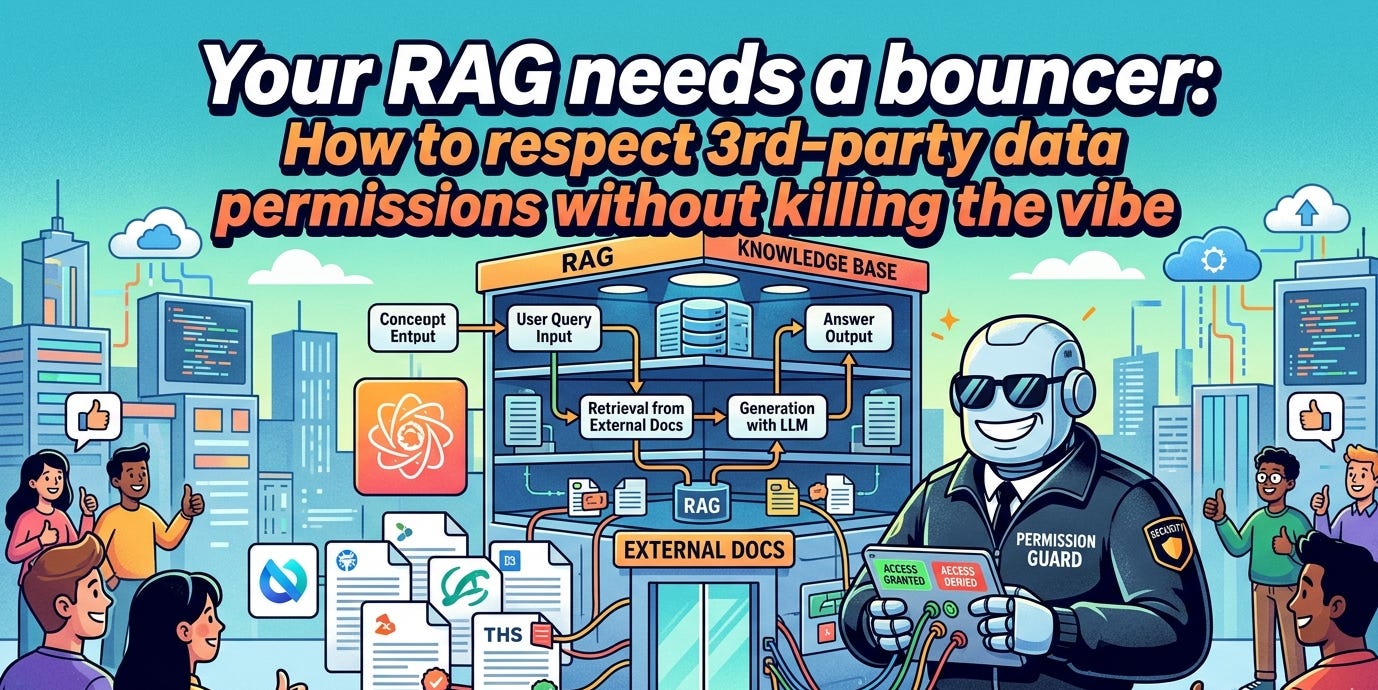
Your RAG needs a bouncer: How to respect 3rd‑party data permissions without killing the vibe
Imagine your AI assistant as a curious party guest. Retrieval-Augmented Generation (RAG) lets it mingle—asking Salesforce for notes, peeking at Notion docs, skimming Slack threads. Fun, until your guest wanders into a VIP room they weren’t invited to. That’s what happens when RAG ignores third‑party permissions. Trust evaporates, ToS get violated, and suddenly your “smart” feature is a liability.
Here’s how to keep your AI charming, useful, and permission-aware—without ruining the party.
Bring identity to the dance floor
Always query third‑party data on behalf of the actual user, not a “god mode” service token.
Use OAuth/OIDC tokens tied to the user’s identity and scopes; refresh tokens responsibly.
Propagate user context end-to-end so retrieval filters can enforce the same ACLs the source system does.
2. Scope like a laser, not a floodlight
Request the smallest OAuth scopes you need, when you need them.
Explain why in your consent screen (“We need read access to your Drive to answer document questions.”).
Escalate scopes only at the moment of use and only with clear prompts.
3. Tag everything at ingest
When you chunk and embed content, attach rich metadata:
tenant_id, user_id (or resource owner)
source system and resource type (e.g., drive.file, slack.message)
sharing state and ACLs (private, shared, channel, org)
last_modified, retention, and compliance flags
These tags become your guardrails: you can’t filter what you don’t label.
4. Gate the R in RAG
Put a policy gate before “R”: retrieval should filter by:
tenant isolation and row-level security
user’s current scopes and group memberships
document- and field-level access (masking where needed)
Only after the gate passes should results head to the LLM for generation.
5. Don’t let your vector DB overshare
Use per-tenant namespaces or physically separate indexes.
Filter by metadata before similarity search (or with hybrid search that respects filters).
Never embed raw secrets or sensitive PII. Redact or hash fields; chunk narrowly to minimize bleed-over.
6. Cache without getting creepy
Cache results per user and per question; encrypt at rest; short TTLs.
Never share caches across users or tenants.
Invalidate fast on permission changes (webhooks from the source system help here).
7. Live by revocation and deletion
When a file is unshared or a user is deprovisioned, remove or tombstone those chunks and purge caches.
Support a right-to-be-forgotten flow that traverses your indexes, logs, and backups.
Maintain audit trails: who asked, what was retrieved, why it was allowed.
8. Test like a villain
Write red-team tests: can a user in Team A retrieve Team B’s docs? What about shared links? Private channels? Soft-deleted files?
Simulate scope downgrades and expired tokens. Your RAG should fail closed, not open.
A simple permission-aware RAG flow
Ingest: Pull third‑party data with least-privilege scopes; normalize and tag metadata.
Index: Store chunks in tenant-scoped namespaces with ACL metadata.
Retrieve: On each query, evaluate policy with the caller’s identity and scopes; filter before similarity search.
Re-rank: Keep filters applied; never “promote” documents the user can’t see.
Generate: Pass only allowed snippets to the LLM; mask sensitive fields.
Observe: Log decisions, monitor denials, and surface explainability (“Not included due to document permissions.”).
Purge: React to webhooks for revocations and deletes; rotate keys and tokens.
Practical tips to ship faster
Use integration tooling (e.g., platforms like Paragon) to handle OAuth flows, granular scopes, webhooks, and sync scheduling. That frees you to focus on policy evaluation and safe retrieval.
Keep a permissions mirror: periodically reconcile your stored ACLs against the source-of-truth.
Offer graceful fallbacks: if access is missing, ask for just-in-time consent instead of failing silently.
Bottom line: Great RAG isn’t about finding the most data—it’s about finding the right data for the right person at the right moment. Treat third‑party permissions like the velvet rope they are. Your users (and their security teams) will thank you, and your AI will keep the party going without stepping on any toes.