
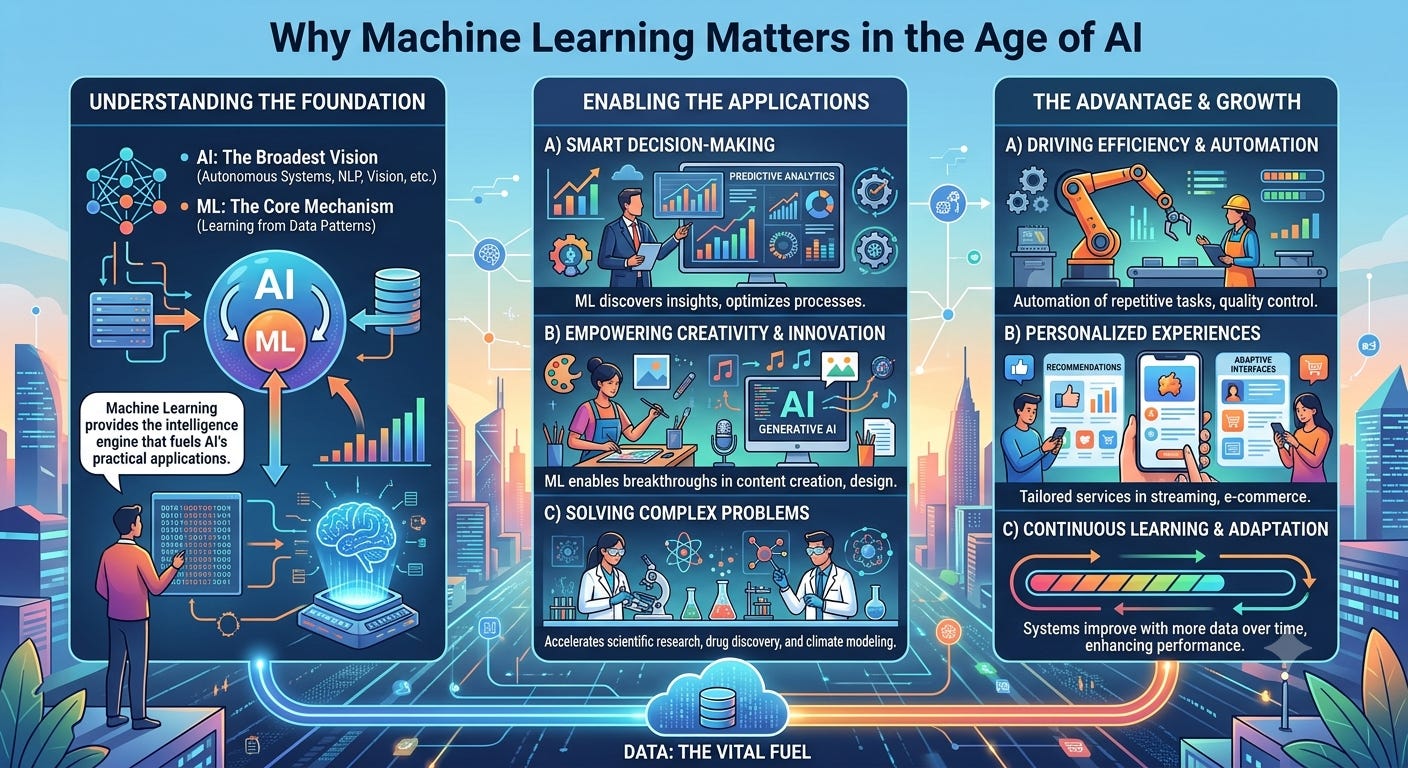
Why machine learning matters in the age of AI
AI feels magical—type a prompt, get an answer. But behind that magic is machine learning (ML), quietly doing the heavy lifting. ML is what helps AI learn patterns, organize chaos, and turn raw data into something useful. And here’s the hard truth: if your data isn’t well formed or well categorized, your AI’s outputs will be fragmented—shallow, inconsistent, or just plain wrong.
Think of AI like a world-class chef. If the pantry is messy—ingredients mislabeled, half-expired, and scattered—no recipe comes out right. ML is the system that stocks the pantry: it labels, cleans, groups, and prioritizes the ingredients so the chef can create something consistent and delicious every time.
Why “garbage in, garbage out” is painfully real now
Modern AI, especially large language models (LLMs), is great at composing language—but it still depends on what it can learn and retrieve.
When your documents, logs, tickets, or product data are noisy, duplicated, or poorly tagged, models struggle. They retrieve the wrong context, hallucinate, or contradict themselves.
Fragmented data leads to fragmented answers. You’ll see this as vague summaries, missing steps, or answers that shift from one prompt to the next.
Where ML earns its keep ML doesn’t just train models—it shapes the very data those models depend on.
Structure from unstructured: ML can classify documents, extract entities, detect topics, and turn free text into structured signals.
Smarter retrieval: With embeddings and clustering, related content actually lives together, so LLMs pull the right facts when you ask a question.
Consistent language: ML-powered normalization and taxonomy mapping reduce “multiple names for the same thing,” a common cause of confused answers.
Feedback loops: ML learns from user clicks, ratings, and corrections, continuously improving what the AI surfaces next time.
A quick story A support team launched a chatbot on top of thousands of help articles. The first week, customers got inconsistent answers. Why? Articles weren’t tagged, product names varied across teams, and duplicate content fought for attention. After introducing ML-driven classification, entity extraction (standardizing product and feature names), and de-duplication, the chatbot’s correct-answer rate jumped—without changing a single prompt.
What “well formed and categorized” really means
Clear schemas and taxonomies: agreed names for products, features, and processes.
High-quality metadata: owners, dates, versions, regions, and access levels.
Clean, deduplicated content: one canonical source of truth per topic.
Embedding-rich indexes: content represented in a way models can “understand” semantically.
Guardrails and evaluation: test sets, relevance metrics, and regular audits to catch drift.
If you’re building with AI, start here.