
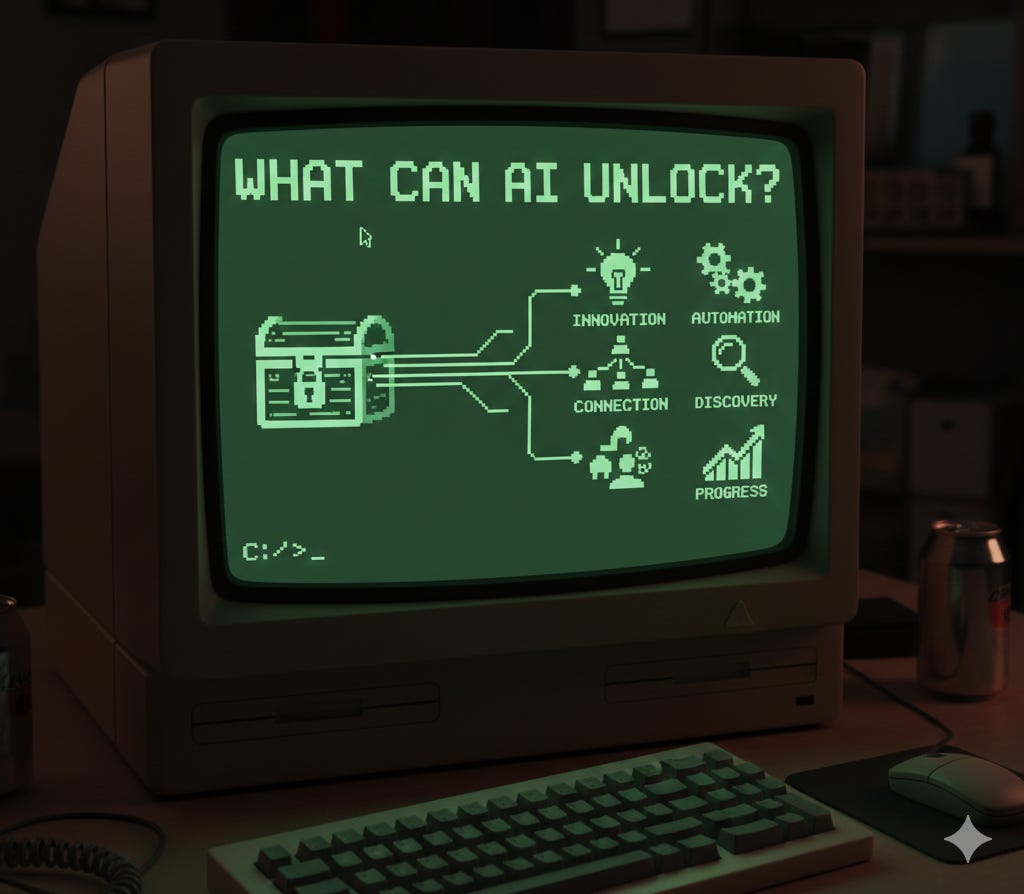
Every breakthrough begins with a question: what if? Artificial intelligence turns those what ifs into workable plans. It’s not magic. It’s an enabler—a set of tools that remove friction, amplify human judgment, and open doors that used to be sealed by cost, time, or complexity.
At its core, AI does three things unusually well: it recognizes patterns in oceans of data, it automates repetitive cognitive work, and it generates new options—text, images, designs, scenarios—that we can explore and refine. That combination doesn’t replace us; it expands the frontier of what’s possible for us to attempt.
Consider discovery. In healthcare, models that once took months to screen molecules now propose promising drug candidates in days, narrowing the search so scientists can focus where it matters. In materials science, AI suggests novel compounds for lighter planes or recyclable packaging, reducing trial-and-error. Climate researchers are running ultra-fast weather and crop simulations that help farmers water smarter and cities prepare earlier.
In creative fields, AI is a sketchpad that never tires. Writers use it to rough out structures they polish later. Designers iterate on styles in minutes instead of days, finding unexpected directions. Musicians explore new textures and arrangements. The point isn’t to outsource creativity; it’s to banish the blank page and widen the horizon of choices.
In operations, AI becomes a quiet co-pilot. Retailers forecast demand with far greater precision, cutting waste. Manufacturers catch anomalies before machines fail, reducing downtime. Logistics teams continually reroute around disruption. Customer support shifts from reactive to anticipatory, with agents augmented by assistants that surface context and suggestions.
AI also makes experiences more personal and more accessible. Real-time translation and captions shrink language barriers. Learning platforms adapt to how each student grasps a concept. Healthcare chatbots help patients navigate benefits in plain language. And small teams suddenly operate with big-company leverage: automated back-office tasks, smarter outreach, and dashboards that answer questions you used to send to an analyst.
Perhaps most transformative is how AI changes the cost of experimentation. When you can spin up a simulation, a prototype, a marketing variant, or a piece of code in minutes, you run more tests, learn faster, and say yes to bolder bets. Natural-language interfaces lower the bar to building: describe what you want, and a first draft appears—rough, but ready for your judgment.
Enablers also require guardrails. The most successful teams pair AI with human oversight, document how models are used, check for bias, secure data, and measure outcomes against clear goals. Trust is part of the product.
If you’re wondering where to start, try this:
Pick a stubborn bottleneck that costs time or drains energy.
Define what “better” means—speed, quality, cost, experience.
Pilot a narrow use case with a human in the loop.
Measure, iterate, and scale only when the value is clear.
Don’t ask whether AI will replace you; ask what it can unlock when it works beside you. The future isn’t man versus machine. It’s teams that learn to ask better questions—and use AI to turn possibility into practice.