
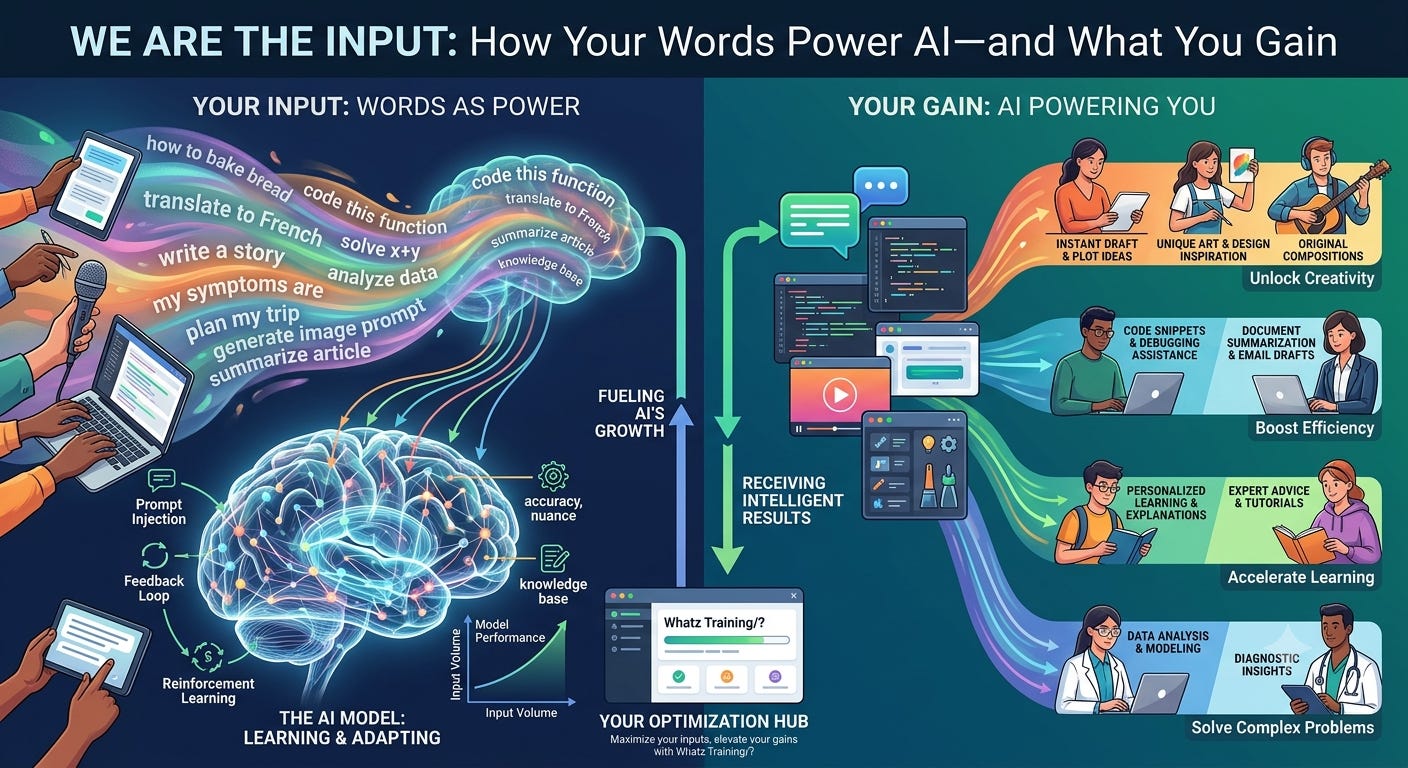
Every status update, research abstract, headline, and how‑to guide is part of a giant, living knowledge stream. Modern AI—especially large language models (LLMs)—drink from that stream. They learn by absorbing patterns in our collective output: the structure of arguments, the rhythm of storytelling, the logic in code, the way facts fit together. That process is called training.
Training doesn’t mean memorizing every sentence. It means compressing vast amounts of human expression into statistical patterns that help a model guess what comes next: the next word in a sentence, the next step in a plan, the next line of code. The sources are wide and varied—web pages, research papers, books, public datasets, and human-created examples—curated to teach the model how we write, reason, and solve.
That’s why AI feels “real world.” It reflects us. It inherits our brilliance and our blind spots, our consensus and our controversy. Ask it a question and it draws on that compressed map of knowledge to produce a response. Useful? Often. Perfect? Never. Because the real world is messy, and models echo the mess.
Here’s the unique advantage for the everyday user: you don’t have to buy the supercomputer that makes any of this possible. The cost and complexity of training live elsewhere. You get on‑demand leverage—like tapping into a power grid instead of building your own generator. In seconds, you can:
Draft and iterate: From emails to essays to outlines, the blank page becomes a starting line.
Summarize and compare: Distill articles, reports, or meeting notes, then stack viewpoints side by side.
Prototype ideas: Try multiple tones, structures, or code snippets without spinning up a dev environment.
Translate across formats: Convert notes into slides, policies into checklists, data into narratives.
That’s computational leverage, rented by the minute. You bring intent and context; the model brings speed and pattern recognition.
But leverage without judgment is a liability. Because models reflect the world, they can carry bias, dated information, or confident errors. The fix isn’t to opt out of AI—it’s to become a better conductor:
Feed context: Give background, constraints, and audience. Vague in, vague out.
Show and tell: Provide examples of the style or structure you want.
Ask for structure: Headings, bullet points, tables of pros/cons improve clarity and make checking easier.
Verify claims: Scan for sources, cross‑check facts, and keep a human in the loop for decisions that matter.
Close the loop: If something’s off, say how. Iteration teaches the model what “good” means for you.
There’s a deeper trade at play. We’ve all contributed to the world’s digital memory—knowingly or not. AI turns that memory into a tool anyone can use. The responsibility on our side is to raise the signal: publish clearly, cite well, respect privacy, and share original insight. The responsibility on the model’s side—via its builders and operators—is to improve transparency, reduce bias, and keep the systems safe.
LLMs are built on our outputs, but the point isn’t to replace us. It’s to widen the aperture of what one person can do in an afternoon. The models learn from the world we’ve made. We, in turn, can use them to make the next draft of it—faster, fairer, and more thoughtfully our own.