
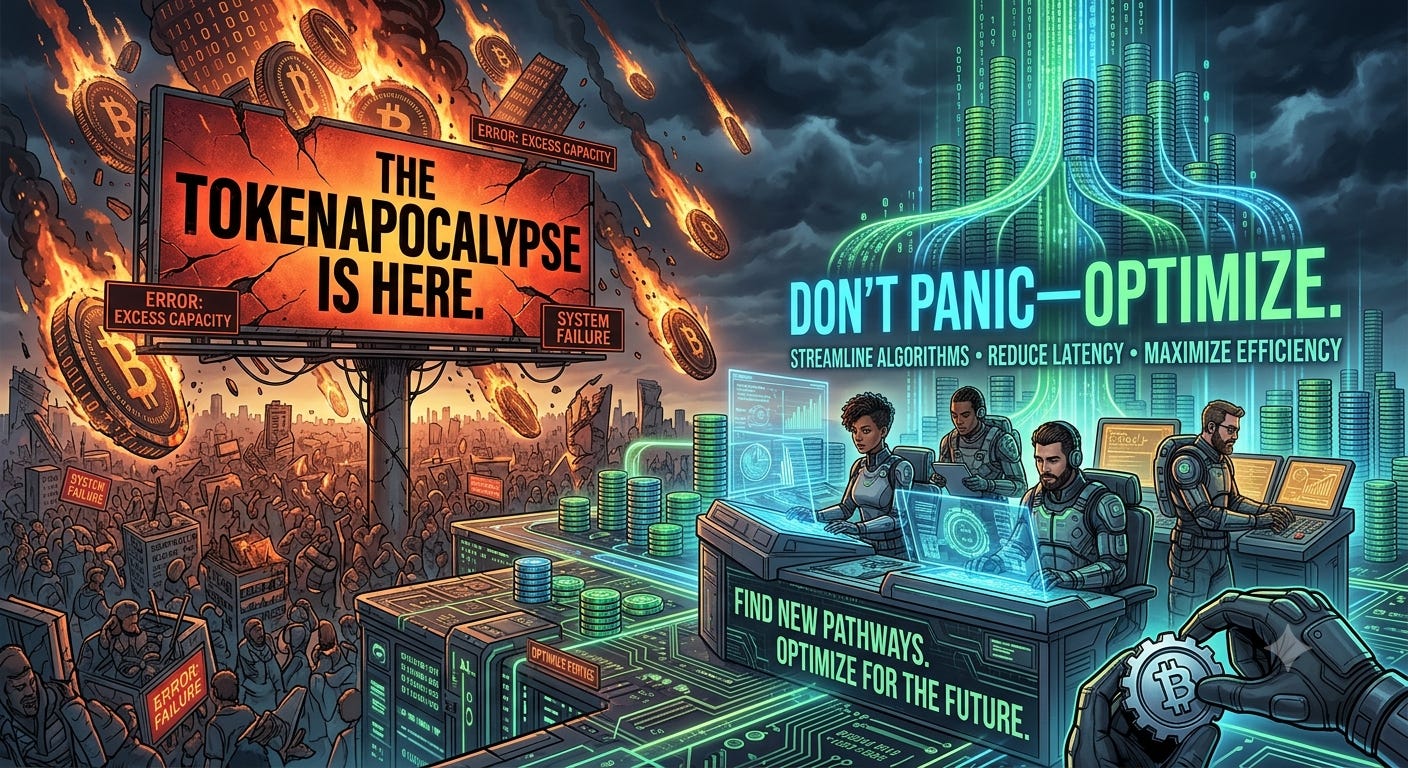
First it’s a quiet line item. Then the finance alert pings: “AI spend doubled—same query volume.” Welcome to the tokenapocalypse: rising token prices, fatter prompts, and sprawling contexts turning clever pilots into runaway bills. The answer isn’t to shrink ambition; it’s to design for cost per task, not cost per token, and put ruthless discipline into how you produce, move, and consume tokens.
A practical playbook to cut 30–70% of LLM spend without gutting quality:
Right-size the model
Use model cascades: cheap, small models for intent classification, extraction, and easy Q&A; escalate to a premium model only on failure or uncertainty.
Fine-tune or instruct-train a smaller model for narrow domains; reserve frontier models for truly hard cases.
Put a ceiling on context
Trim system prompts; canonicalize instructions and reference them by short tags instead of pasting walls of text.
Cap history: roll up long threads into compact running summaries; keep raw transcripts off the wire.
Retrieval that pays for itself
Prefilter with keywords/BM25 before vector search to cut embedding calls.
De-duplicate and chunk smartly (overlap only where it helps); use lower-dim embeddings when acceptable.
Cache top-K retrieval results per intent or user cohort; most questions repeat.
Cache like you mean it
Deterministic tasks (temperature 0) are cacheable. Normalize prompts and use response caching.
Introduce a semantic cache for “near-duplicate” asks to avoid recomputing whole answers.
Constrain generation
Set max output tokens aggressively; stream and early-stop when you have enough to act.
Use structured outputs (function calling, JSON schemas) to avoid verbose prose and cleanup retries.
Prefer low temperature for utility tasks to reduce rewrites.
Reduce retries at the source
Validate inputs before the model; bounce bad parameters with clear errors.
Add stop sequences, guardrails, and deterministic templates to cut meandering outputs.
Optimize the RAG loop
Embed once, use everywhere: batch embedding jobs and reuse across products.
Rerank a small candidate set instead of feeding the whole corpus to the LLM.
Infrastructure knobs (if you run your own)
Use modern inference stacks with paged/KV cache reuse and speculative decoding.
Quantize where quality holds; batch requests to saturate GPUs.
Budget-aware UX
Set user-facing “verbosity” controls; reward concise answers and bullet formats.
Offer short/long toggle and charge internal budgets accordingly.
Observability and unit economics
Track tokens per intent, per user, and per step in a workflow.
Tie cost to business outcomes: cost per resolved ticket, per qualified lead, per successful action.
Alert on drift: sudden context bloat, rising retries, or model fallbacks.
Fast 90-day plan
Week 1–2: Instrument everything. Baseline tokens in/out, retries, latency, and cost per task. Identify top 10 expensive prompts and flows.
Week 3–4: Implement cascades, cap context, introduce caching, and enforce max tokens. Switch verbose prose to structured outputs.
Week 5–8: Retrofit RAG with prefilters and reranking; dedupe and re-chunk the corpus; batch embeddings.
Week 9–12: Fine-tune a smaller model for your highest-volume intents; negotiate pricing/commits; turn on anomaly alerts and budget guards.
Negotiation and model hygiene
Pick models on the cost–quality frontier, not hype. Large context windows are a tax—only pay it when you must.
Use committed spend, region selection, and throughput tiers to lower unit price.
Keep two vendors and a roll-back model to avoid lock-in and pricing shocks.
The tokenapocalypse isn’t doom; it’s discipline. Teams that treat tokens like a scarce resource—measured, cached, constrained, and right-sized—won’t just survive. They’ll ship faster, scale cleaner, and turn AI from an R&D expense into a predictable, efficient engine.