
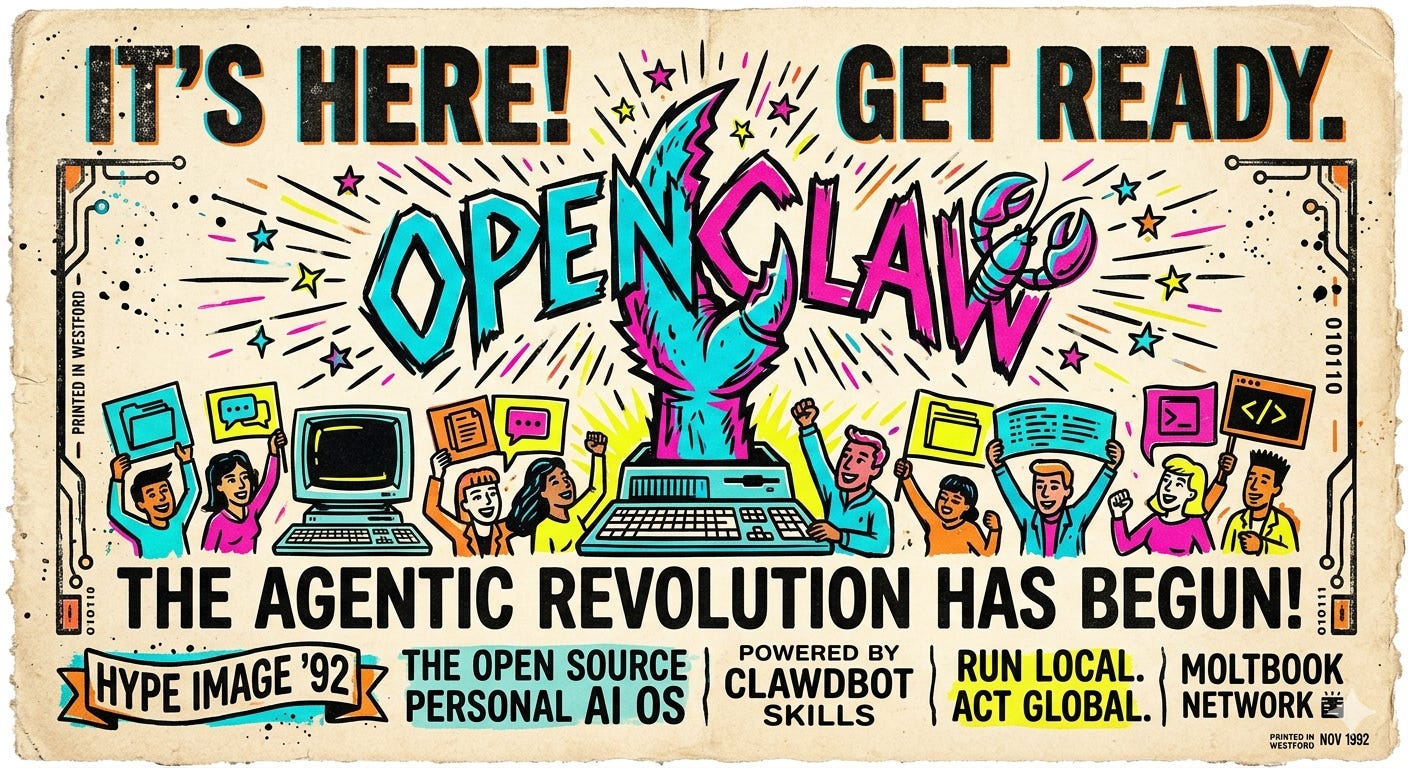
Your feed is probably full of OpenClaw right now—threads, demos, breathless benchmarks, and a creeping sense that you might be late if you’re not already “building on it.” Hype cycles are useful; they mobilize attention and resources. They’re also blinding. Before we elevate OpenClaw to silver-bullet status, it’s worth pausing to ask the unglamorous questions that keep projects alive after the buzz fades.
What’s fueling the hype Every wave has the same ingredients: eye-popping demos, a few early success stories, and claims that this time the trade-offs are gone. Depending on what OpenClaw actually is for you—a model, an agent framework, a platform, or a toolkit—the promises probably rhyme: better performance, lower cost, easier integration, more “openness.” Some of that may be true. The work is figuring out what holds outside a conference stage.
What to be careful about
Benchmarks versus reality: Demos are often cherry-picked. Check what datasets were used, whether prompts or workloads were tuned, and if comparisons are apples-to-apples. Reproduce results on your own data and constraints.
Hidden costs: Licensing, compute, storage, egress, fine-tuning, human evaluation, and on-call time add up. Model or platform wins can be erased by orchestration complexity and monitoring overhead.
Security and supply chain: Verify provenance, signatures, and dependencies. If you’re pulling models, containers, or plugins, scan them. Treat any “open” artifact like third-party code: threat model it.
Data privacy and IP: Know where your data flows. Are weights or logs phoning home? What rights do you grant when you submit data for training or telemetry? Read the license and the data policy, not just the homepage.
Reliability and failure modes: How does it degrade under load, network partitions, or partial outages? Can you bound latency and error rates? What’s the rollback path if an update regresses quality?
Governance and compliance: Map features to your actual obligations (PII, HIPAA, SOC 2, GDPR, export controls). “Open” doesn’t mean “compliant,” and “lab-only” features can leak into production by accident.
Lock-in by convenience: Even with open components, proprietary glue (APIs, hosted add-ons, file formats) can trap you. Test migration paths and data portability now, not later.
Community and roadmap risk: Who maintains it? Is there a bus factor? Are issues triaged, CVEs disclosed, and roadmaps credible? A vibrant repo is not the same as a sustainable project.
Ethics and misuse: If OpenClaw lowers barriers to automation or content generation, consider bias, safety, and abuse vectors. What guardrails exist, and who bears the fallout when they fail?
How to try it without getting burned
Define success up front: Pick clear, measurable outcomes (quality, latency, cost per task, incident rate). Decide what would make you stop the pilot.
Start where failure is cheap: Non-critical, reversible use cases first. Keep humans in the loop until you have strong evidence you can remove them.
Build a safe harness: Sandbox environments, rate limits, input validation, content filtering, and audit logging from day one.
Test like it will fail: Chaos test, red-team prompts or inputs, simulate upstream API slowness, and rehearse rollbacks.
Measure continuously: Instrument for accuracy, drift, cost, and user impact. Compare against a strong baseline—not a strawman.
Involve the right people: Security, legal, and procurement early. If you need model or data governance, stand it up before adoption, not after.
Plan the exit: Document how to swap components, export data, and revert to your previous stack. Avoid single points of expertise.
The bottom line OpenClaw might be a breakthrough for your stack—or just the latest wave passing through. The difference won’t be decided by a launch thread; it will be decided by your due diligence. Celebrate the potential, but make it earn its place. In a year, you’ll be glad you asked the boring questions.