
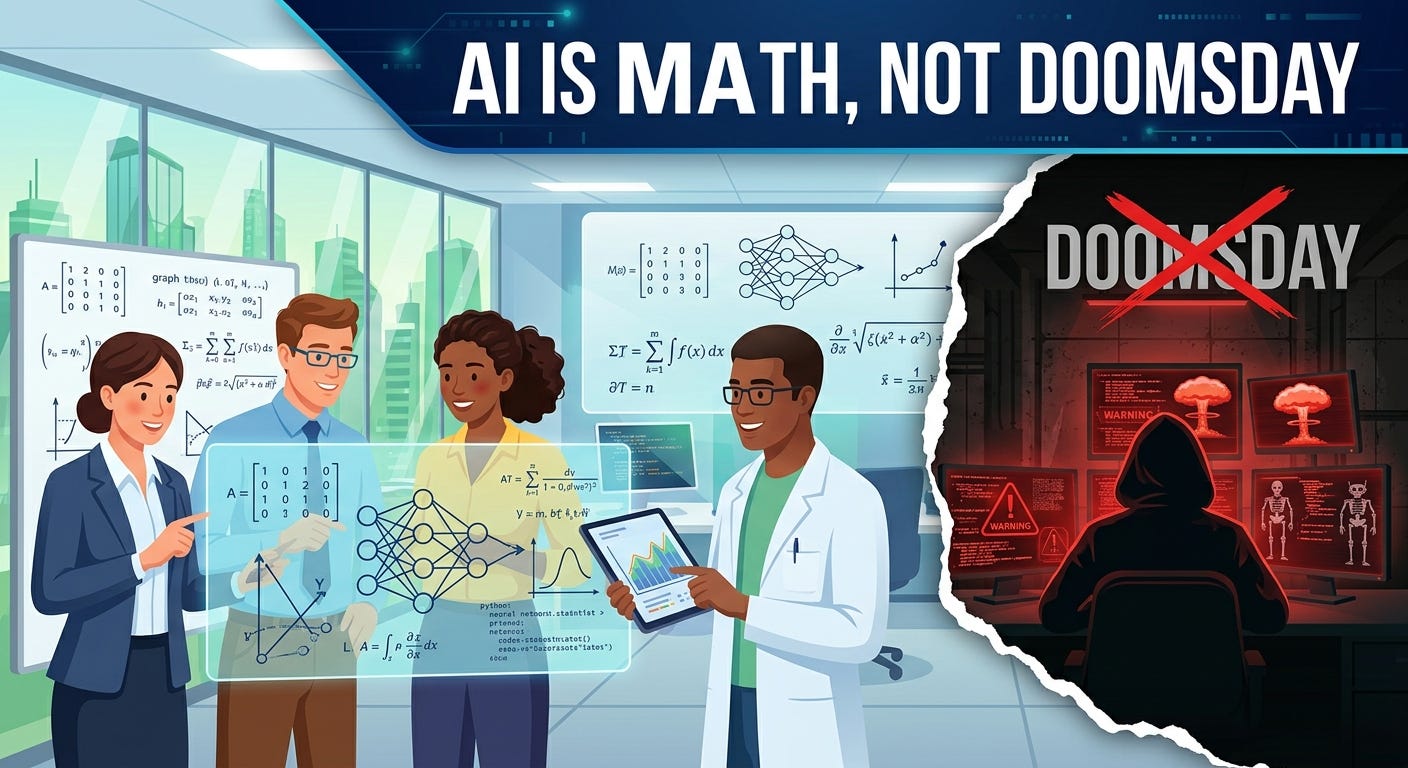
Picture a lens. On its own, it doesn’t create light or darkness; it focuses what’s already there. AI is that lens. The same algorithms that flag skin cancer can also generate deepfakes. The difference isn’t a mystical property of the machine—it’s the goal we set, the data we feed it, and the guardrails we build around it.
AI is a calculator with a mission. It ingests patterns, optimizes an objective, and outputs a decision. No hunger, no fear, no vendetta—just math. That’s why “AI for good” and “AI for bad” can be two faces of the same system. Spam filtering and spearphishing rely on similar language models. Recommendation engines can connect people to lifesaving resources—or pull them into disinformation spirals. It’s not destiny. It’s direction.
So why the doomsday headlines? Because scale changes the stakes. Small errors, amplified across millions of decisions, can become big harms. Mis-specified goals can send a system sprinting in precisely the wrong direction. And once we weave AI into infrastructure—healthcare, finance, energy—the cost of failure rises. None of that makes AI an existential monster. It makes it a powerful tool that demands disciplined use.
Here’s the practical way to think about it: the story of AI is the story of instructions.
What are we asking it to optimize? Accuracy at any cost, or accuracy with fairness, safety, and privacy constraints?
Whose values and data does it learn from? Inclusive, vetted datasets—or biased, brittle, scraped-at-random noise?
What happens when it’s wrong? Are there fail-safes, audits, and rollbacks—or a blind trust in automation?
Who’s accountable? A nameless model—or a team with ownership and a paper trail?
When those questions have good answers, AI does quiet, transformative work: predicting equipment failures before they become disasters, translating between languages in emergency rooms, compressing workloads so people can focus on judgment and care. When they don’t, we get brittle systems, shadowy incentives, and scary headlines.
If we want more of the former and less of the latter, the playbook is refreshingly human:
Design with constraints, not just objectives. Build safety, privacy, and fairness into the target function.
Test like an adversary. Red-team models before real users do.
Keep a human in the loop where stakes are high. Judgment beats speed when lives or rights are on the line.
Monitor in the wild. Models drift; feedback loops matter; shutoff switches should be real.
Be transparent. Document data sources, limitations, and intended use so others don’t overtrust or misuse the system.
Align incentives. Reward outcomes that reflect societal value, not just engagement or short-term clicks.
The future won’t be written by an algorithm. It’ll be written by the people who set the objectives, pick the data, shape the policies, and decide where to deploy the lens. AI is not a savior and not a supervillain. It’s a mirror with math, reflecting our goals at scale.
The apocalypse isn’t coded in. The instructions are.