
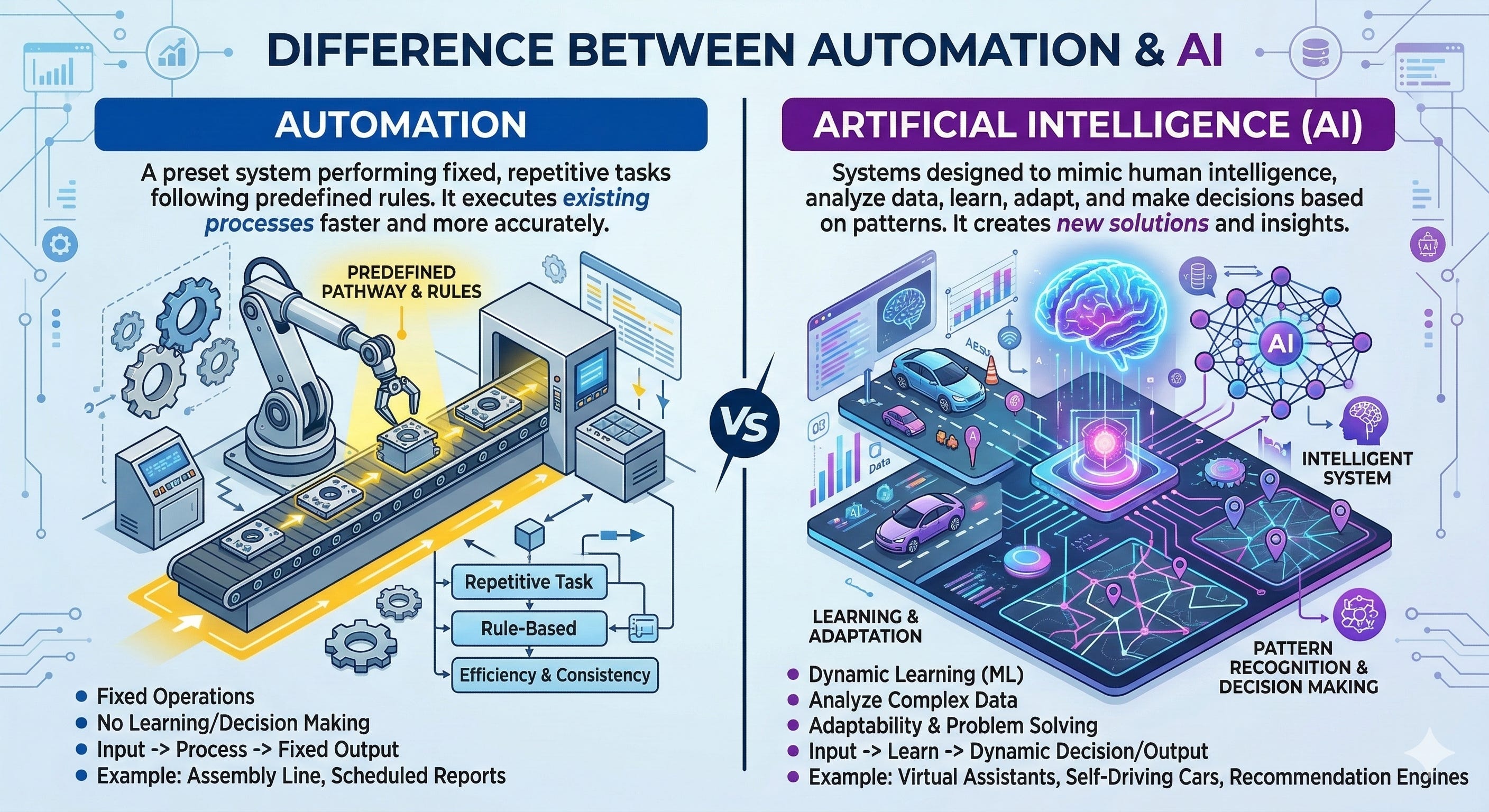
Picture a factory line and a research lab. On the line, machines do the same thing, the same way, every time. In the lab, scientists explore patterns, test hypotheses, and adapt. That’s the core divide: automation is the line; AI is the lab.
What automation is
Automation executes predefined, stable rules at speed and scale.
It’s deterministic: if X happens, do Y. Think RPA filling forms, CI/CD pipelines deploying code, a conveyor moving items, a script reconciling transactions.
It shines where processes are repeatable, inputs are structured, and outcomes are unambiguous.
What AI is
AI learns patterns from data to make judgments under uncertainty.
It’s probabilistic: given messy inputs, it predicts or generates the most likely useful output. Think fraud detection, demand forecasting, defect detection in variable lighting, language models answering nuanced questions.
It shines where rules can’t be fully written down, inputs are ambiguous, or the environment shifts.
Different methodologies under the hood
Automation: process mapping, rule capture, BPM, RPA, APIs, deterministic workflows. Validation is pass/fail.
AI: data collection and labeling, model training, evaluation, drift monitoring, MLOps. Validation is statistical (accuracy, precision/recall, calibration).
Different failure modes
Automation breaks on exceptions it wasn’t told about. Fix by adding rules.
AI degrades when data changes or was biased/noisy. Fix by retraining, feature changes, or model choice.
Different metrics and governance
Automation: cycle time, throughput, error rate near zero, auditability by design.
AI: model accuracy, fairness, explainability, confidence thresholds, continuous monitoring.
Why these terms shouldn’t be used interchangeably
They imply different scopes. “We need AI for invoice processing” may really need automation with OCR and rules. Overspecifying inflates cost and risk.
They drive different teams and budgets. Automation is an ops and process effort; AI is data science plus product iteration.
They set different expectations. Automation promises consistency; AI promises judgment. Mixing the language muddies success criteria.
Use cases that draw a clean line
Choose automation when:
The path is known and stable (account provisioning, report generation, batch data moves).
Compliance demands strict, explainable rules.
You want immediate, predictable ROI from repetitive tasks.
Choose AI when:
You’re classifying, predicting, or interpreting messy signals (emails, images, audio, free text).
The decision relies on patterns too complex to codify (churn risk, personalized recommendations).
The environment changes and the system must adapt over time.
Where they meet—without conflation Automation is the backbone; AI can be the brain. A claims workflow (automation) can route a document to a model that extracts fields and flags anomalies (AI), then continue the process. They can live in the same system, but they are not the same thing.
Decision test you can apply in a minute
Can a subject matter expert write the rules on a whiteboard and expect them to hold for months? If yes, automate.
Do experts rely on experience with patterns and exceptions, and do those patterns shift? If yes, AI.
Do you need both speed and judgment? Orchestrate: automation for flow, AI for insight, with human oversight.
Say it precisely
“Automate approvals for low-risk cases.”
“Use AI to read contracts and flag non-standard clauses.”
“Automate the handoffs; use AI for the interpretation.”
Keep the line clear, and you’ll scope faster, build cheaper, and ship solutions that actually work.