
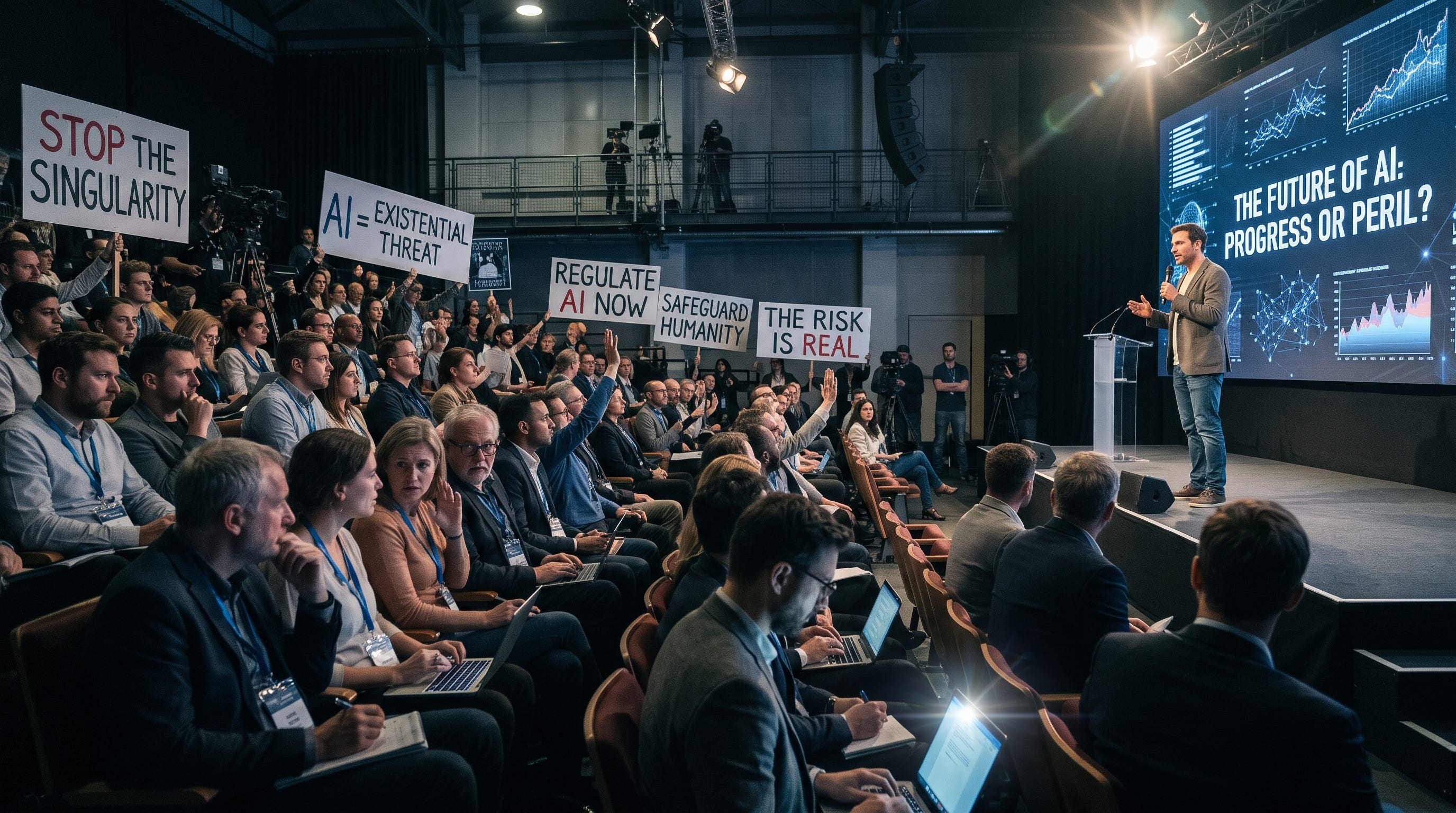
It’s surreal. Many of the same luminaries who built the tools that streamline our work, improve our health, and make today feel like extraordinary science‑fiction times now warn that AI could end the human race. That leap—from transformative to terminal—deserves more than vibes and headlines. It deserves evidence.
Technology isn’t destiny; it’s intent, design, and governance. A tool can be used or misused, but “misuse” isn’t an automatic synonym for “extinction.” If you believe AI poses an existential threat, spell out the pathway—concretely. Dont spread useless narratives because people follow you. The masses have trust in you, do not break that barrier.
For the masses - do not fall to the rhetoric. The press is doing a great job of going to extra lengths to prove this is all going to end us all. NO
Here’s the bar a credible “AI ends humanity” claim should clear:
Mechanism: Describe the exact chain of events. What capability, in what system, acting through which interfaces, leads to irreversible, global harm? Not “could” or “might”—how, step by step.
Preconditions: What needs to be true for that mechanism to work? Autonomy? Self-replication? Covert access to critical infrastructure? What’s missing today?
Timelines and leading indicators: What measurable signs would show we’re on that path within 6, 12, 24 months? Model benchmarks? Tool-use competence? Breakouts from sandboxes? Be specific.
Empirical grounding: Point to incidents or experiments that foreshadow the mechanism—alignment failures, scalable deception, uncontained agent behavior—along with reproducible data.
Policy relevance: If the risk is real, what precise safeguards (evals, deployment gates, liability, compute thresholds, incident reporting) materially reduce it, and by how much?
That’s how we’ve handled every truly high-stakes technology. Nuclear risk wasn’t managed by op-eds; it was defined through physics, test data, treaties, inspections, and red lines. Aviation safety didn’t improve by panic; it improved via checklists, incident analyses, and accountability.
Right now, the “end of humanity” chorus often collapses distinct concerns into a single catastrophe narrative. Let’s separate them:
Near-term harms we can measure: misinformation, fraud, bias at scale, IP theft, privacy erosion, brittle automation, labor displacement, and misuse in cyber and bio domains.
Medium-term systemic risks: increased accident surfaces as AI tools orchestrate other tools, socio-economic shocks from rapid capability diffusion, and concentrated power over models and data.
Speculative existential risks: autonomous systems gaining strategic leverage over critical infrastructure or coercive capacity without human oversight.
The first two buckets demand urgent work—today. The third demands rigor, not theater. If you’re convinced we’re flirting with species-level risk, publish a threat model the rest of us can test. Offer falsifiable predictions. Name thresholds that would change your mind. Commit to debate where claims meet counter-evidence, not just cameras.
In the meantime, let’s get on with the practical safeguards that help across all three buckets:
Independent, pre-deployment model evaluations and red teaming tied to go/no-go decisions.
Secure-by-default agent design: limited tool permissions, rate-limits, isolation, and immutable audit logs.
Incident reporting and a public registry of AI failures, like aviation’s ASRS.
Liability that maps responsibility to those who design, deploy, and profit.
Investment in alignment research, interpretability, and resilient infrastructure.
Less prophecy, more proof. Less doom, more design. If you believe AI can end us, show your work. If you can’t, let’s stop shouting “fire” and start installing sprinklers. Crazy times call for clear thinking—and receipts.