
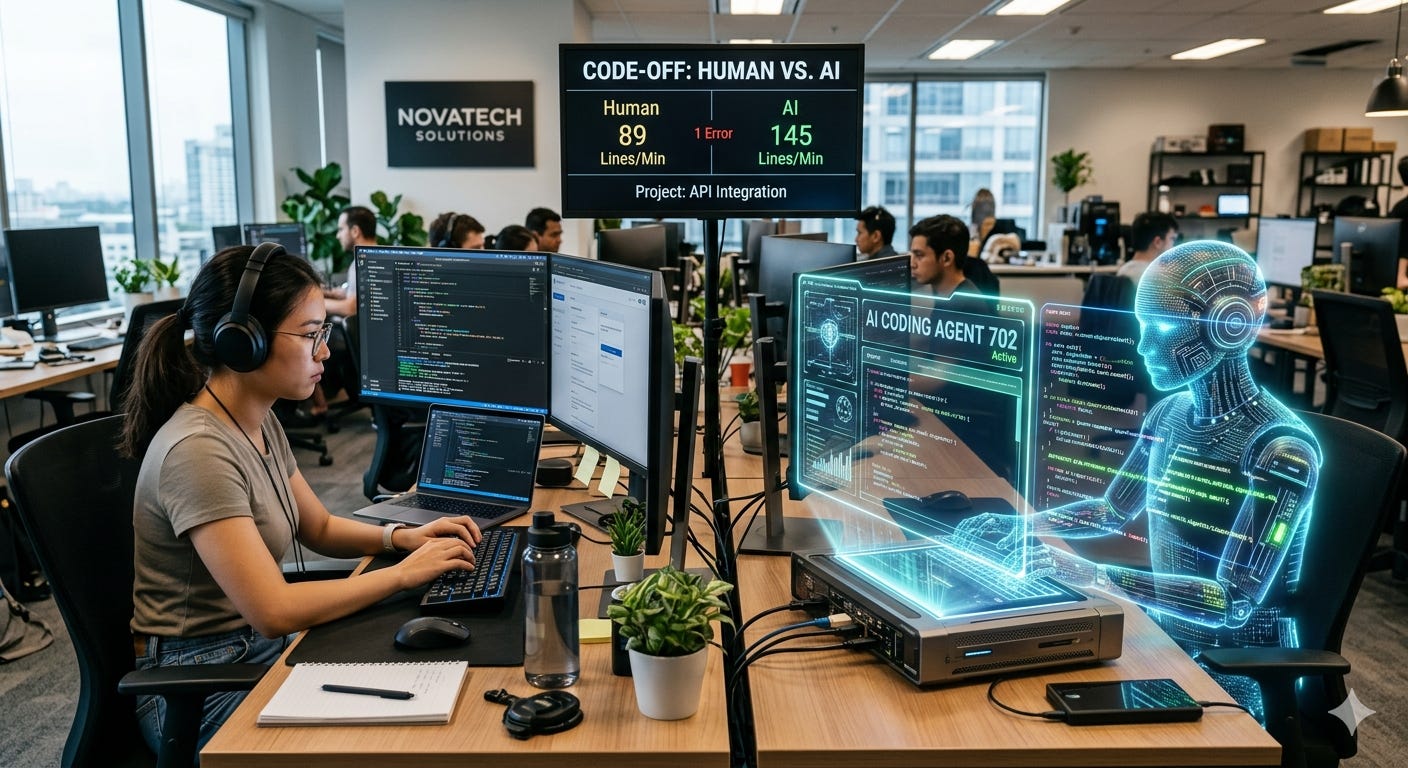
Every few weeks, a new demo shows an AI agent spinning up a feature in minutes. It’s impressive—and it tempts a simple conclusion: if code is getting automated, won’t engineers be automated too? Only if you believe the job is just typing syntax.
In reality, most of the value in software happens before and after a line of code exists. Code is a means; outcomes are the end. AI agents excel at working inside a defined scope. Engineers define the scope, reshape it when the world pushes back, and take responsibility for the consequences.
Consider a familiar scene: a team wants a “simple” pricing service. An AI can scaffold endpoints, write a few tests, and pass a happy-path demo. But shipping it in the real world means wrestling with constraints the agent can’t “see” from a prompt:
Compliance and auditability across regions
Latency SLOs under peak load and partial outages
Versioning and backwards compatibility for existing clients
Guardrails around financial risk and abuse
Cost controls and observability to avoid runaway spend
Rollout strategy, kill switches, and incident playbooks
None of that lives in the ticket. All of it matters to the business.
This is where engineers do their real work:
Problem framing: clarifying the job-to-be-done, uncovering hidden requirements, and saying no to the wrong solution.
System design: choosing architectures, defining interfaces and invariants, and planning for failure modes—not just writing functions that pass a unit test.
Trade-offs: negotiating latency vs. cost, accuracy vs. speed, flexibility vs. simplicity, now vs. later.
Integration: aligning with data governance, security, legal, and operational realities across a messy organization.
Stewardship: owning quality, reliability, and evolution over time, not just v1 demos.
AI agents don’t hold context across shifting goals, regulations, org politics, and human trust. They don’t argue with stakeholders, absorb the nuance of a domain, or accept accountability when an outage hits a critical customer. They optimize a spec. Engineers shape the spec so it maps to reality.
What will change is the shape of the craft. The keystrokes go down; the thinking goes up. Engineers will spend more time:
Writing crisp intents: specs that capture constraints, invariants, and user journeys.
Reviewing and orchestrating: composing agents and tools, checking assumptions, and enforcing guardrails.
Designing tests that matter: property-based tests, chaos scenarios, and observability that proves correctness in production.
Navigating ambiguity: refining scope, sequencing work, and aligning decisions to business outcomes.
AI is a power tool—fast, tireless, pattern-smart. Put in the hands of someone who knows which problems to solve, which corners not to cut, and how to own the result, it multiplies impact. Without that judgment, it multiplies mistakes.
So no, AI agents won’t “take all the jobs.” They’ll take the tasks that were never the point of the job: boilerplate, rote glue, the tenth iteration of the same function. The engineers who thrive will be the ones who think in systems, design for consequences, and treat code as one lever among many to move a business outcome.