
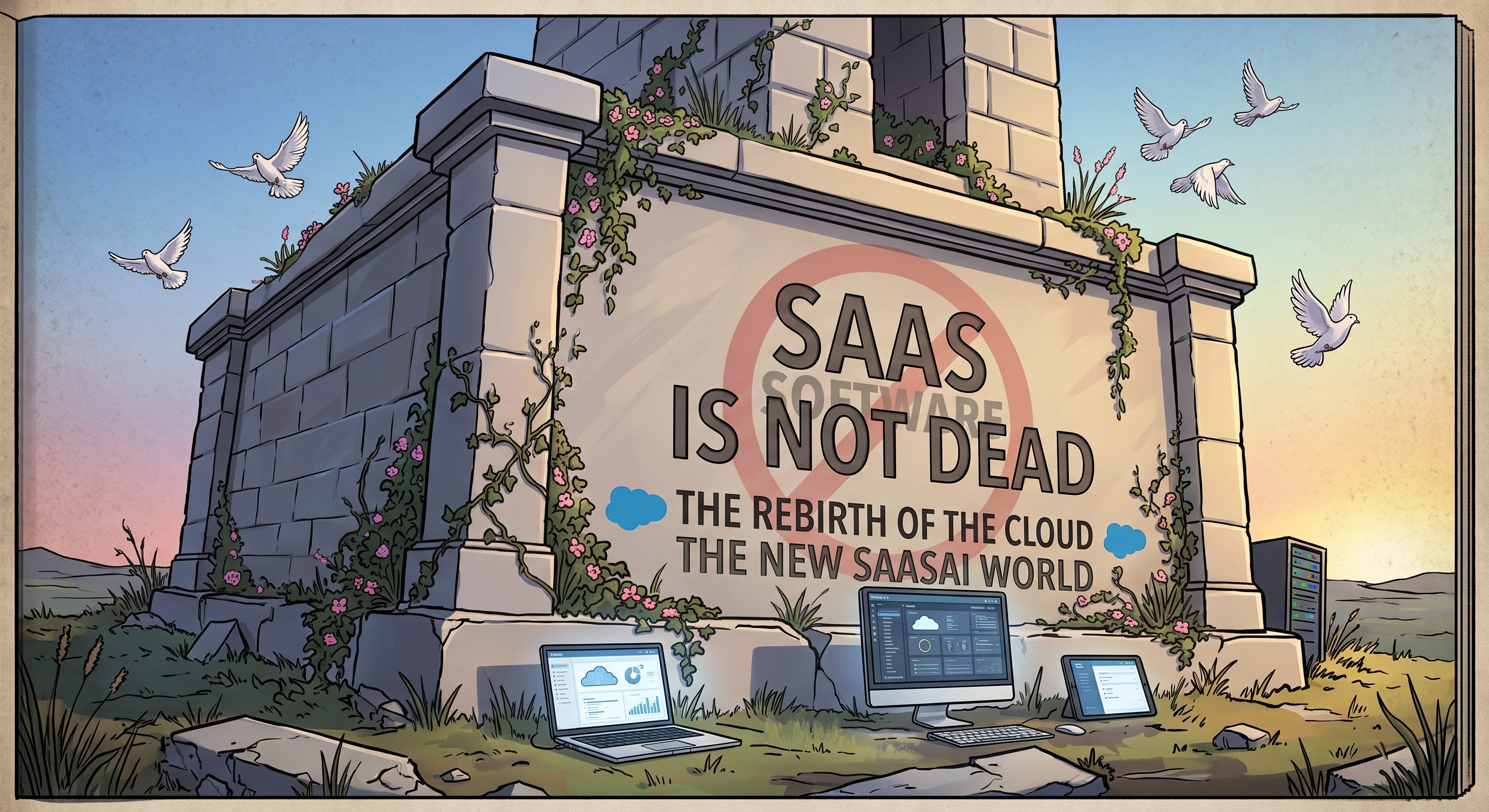
I keep hearing “SaaS is dead. Salesforce is done.” No. Without SaaS, AI is just a bright flashlight on a messy room. The clean data, the definitions, the permissions, the audit trails—all live in your SaaS and data platforms. No SaaS, no AI.
Consider what’s actually happening. Everyone wires ChatGPT or Claude to Salesforce, Snowflake, HubSpot, and internal databases.
Across teams, people ask for “the same” insight: Sales wants pipeline by segment, ARR by cohort, win rate last quarter; Support wants MTTR, CSAT, backlog by priority; Engineering wants defect rate, incident count, error budget burn; Product wants activation, feature adoption, retention; Finance wants revenue by region, bookings vs billings, gross margin. Each person words it differently, and the model infers different filters, joins, time windows, and definitions. One query uses created_at, another closed_at/resolved_at/deployed_at/recognized_at. One rolls up by opportunity owner vs account owner; support queue vs agent; service vs team; user vs account; legal entity vs cost center. Currency conversion? Maybe. GAAP vs cash? It might guess. Attribution window—7, 14, or 30 days? Time zones, fiscal vs calendar quarters, prod vs staging? Five people ask for the “same” KPI, and five polished dashboards appear—with five different numbers.
That’s AI data leak: polished, confident, totally inconsistent outputs from the same source of truth. And in finance and sales, AI bad data doesn’t just waste time; it drives bad decisions. No two reports match, alignment erodes, and the meeting becomes a debate about whose prompt was “right.”
Why this happens:
Prompts embed hidden assumptions. “Revenue” to you is “bookings” to someone else.
LLMs are probabilistic. Slightly different phrasing, slightly different query.
Schema inference is fragile. Inner vs left join, rounding, timezone, date grain—small choices, big swings.
Incomplete grounding. The model fills gaps with guesses when metrics aren’t defined.
Fragmented permissions. Different users can see different rows, so outputs diverge.
Where SaaS wins:
Canonical definitions. Metrics, cohorts, attribution windows, fiscal calendars are codified—not implied.
Governance and lineage. You know who changed what, and why the number moved.
Role-based access. One source of truth doesn’t mean one source of chaos.
Reproducibility. Parameters and versions make yesterday’s “5.2%” also be today’s “5.2%.”
The path forward isn’t “ditch AI.” It’s “let SaaS be the control plane for AI.”
A practical playbook:
Name the truths. Define metrics once in a semantic layer/metrics store (Looker semantic model, dbt Metrics, Cube, etc.). Have AI call metrics by name, not by guess.
Lock the guardrails. Use prompt templates with governed variables (timeframe, segment, currency), reviewed and versioned like code.
Ground every answer. Require the AI to show its work: data source, filters, time window, refresh time—and link back to the canonical report.
Make AI the explainer, not the calculator. Let SaaS/BI compute. Let AI summarize diffs, annotate drivers, schedule, and route insights.
Enforce reproducibility. Cache queries, create sharable run IDs, and log lineage so teams can rerun and match numbers.
Govern identity. Align permissions across tools; avoid per-user data drift that looks like “AI disagreement.”
Put humans in the loop where it matters. Thresholds for finance and sales; auto only on low-risk ops.
AI amplifies whatever it sits on. If that’s well-governed SaaS, you get speed and trust. If it’s ad hoc prompts over raw tables, you get AI data leak—faster.
SaaS isn’t dead. It’s the backbone, the definition layer, the audit trail. AI is the interface. Together, they end bad data. Separately, they just make more of it.